 Admin
Admin 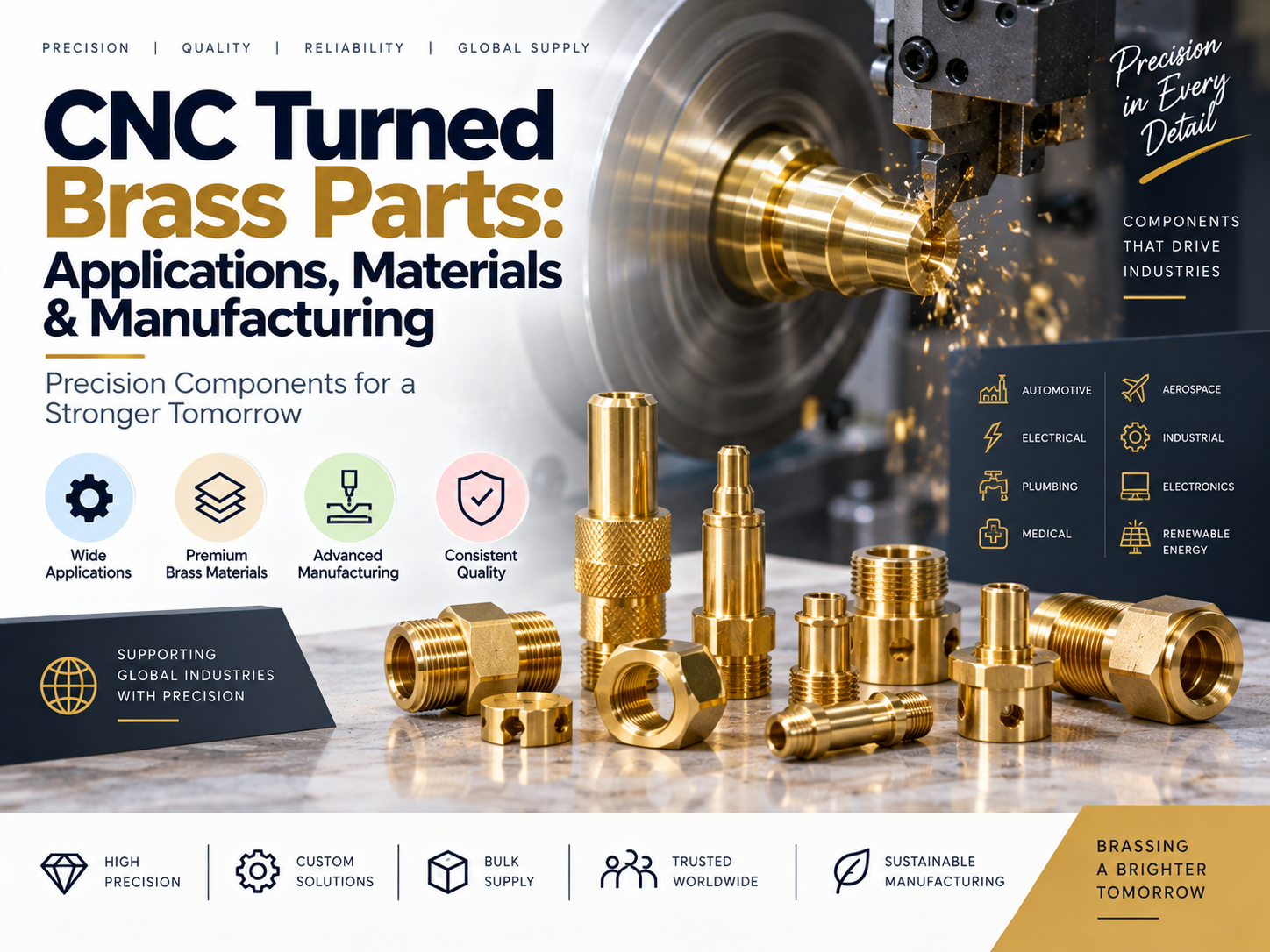
-
Admin
- 04 October 2026
In modern precision manufacturing, CNC turned brass parts are among the most versatile and widely used components across multiple industries. From automotive systems and electrical connectors to plumbing fittings and telecommunications hardware, brass CNC turning delivers the dimensional accuracy, surface finish and material reliability that demanding applications require. This guide covers the key applications, material considerations and manufacturing process behind high-quality CNC turned brass components.
What Are CNC Turned Brass Parts?
CNC (Computer Numerical Control) turning is a subtractive machining process in which a brass workpiece rotates at high speed while a stationary cutting tool removes material to produce a precise cylindrical shape. The process is controlled by computer programming, enabling the production of complex geometries with extremely tight tolerances — often within ±0.005 mm — at high volumes and consistent quality.
Brass is an ideal material for CNC turning due to its excellent machinability rating (the highest of any commercial metal alloy), low cutting resistance, dimensional stability and natural corrosion resistance. These properties make it cost-effective to machine and highly reliable in finished components.
Common Applications of CNC Turned Brass Parts
CNC turned brass components are found across a remarkably broad range of industries and applications:
- Electrical and Electronics – Brass terminals, connectors, pins, sockets and cable glands are widely used because of brass’s excellent electrical conductivity and resistance to oxidation. Our brass electrical parts are manufactured to precise specifications for OEM and export markets.
- Automotive Components – Fuel system fittings, hydraulic connectors, valve bodies, sensor housings and gear components rely on CNC turned brass for its strength-to-weight ratio and resistance to fuel and fluid exposure. Explore our brass auto parts range for detailed specifications.
- Plumbing and Sanitary Fittings – Ball valves, gate valves, compression fittings, elbows and tee connectors in brass offer leak-proof performance and long service life. Our brass pipe fittings are produced to international standards for global supply.
- Instrumentation and Metering – Precision gauges, flow meters and measurement instruments use CNC turned brass housings and internals for their dimensional consistency and non-magnetic properties.
- Telecommunications – RF connectors, antenna fittings and coaxial cable components are often manufactured in brass due to its conductivity and machinability at miniature scales.
Brass Alloys Used in CNC Turning
Not all brass is the same. Different brass alloys offer distinct mechanical and chemical properties suited to specific applications:
- CZ121 / C36000 (Free Cutting Brass) – The most common alloy for CNC turning, containing approximately 58% copper, 39% zinc and 3% lead. Offers outstanding machinability and is used for general-purpose fittings, connectors and fasteners.
- CZ131 (Naval Brass) – Contains tin for enhanced corrosion resistance in marine and high-humidity environments.
- CZ112 (Admiralty Brass) – Used in heat exchangers and condenser tubing due to its resistance to dezincification.
- Lead-Free Brass (C69300, DZR) – Increasingly specified for potable water applications and markets with RoHS compliance requirements — a growing area in Narayan Components’ export portfolio.
The CNC Brass Turning Manufacturing Process
At Narayan Components, the CNC brass turning process follows a structured sequence to ensure every component meets specification:
- Material Procurement – Only certified brass bar stock from approved suppliers is used, with material test certificates maintained for traceability
- CNC Programming – Component geometry is programmed using CAM software with toolpath optimisation for speed and finish quality
- Precision Turning – Multi-axis CNC lathes produce the turned profile with tolerances per customer drawing or international standard
- Secondary Operations – Milling, drilling, threading, knurling and cross-drilling are performed as required in the same setup or on secondary machines
- Surface Treatment – Options include nickel plating, tin plating, chrome plating or natural brass finish depending on application requirements
- Quality Inspection – 100% dimensional inspection for critical features using CMM, gauges and visual inspection protocols
Why Choose Narayan Components for CNC Turned Brass Parts?
Based in Jamnagar — India’s brass parts capital — Narayan Components has over 25 years of experience manufacturing and exporting precision brass components to customers in Europe, North America, the Middle East and Southeast Asia. Our manufacturing capabilities span brass forged components, CNC turned parts, fittings and assemblies — all produced under stringent quality controls to meet international standards including ISO, RoHS and REACH.
Whether you require standard catalogue components or fully custom CNC turned brass parts to your drawings, Narayan Components has the machinery, expertise and export experience to deliver. Contact us today to discuss your requirements and receive a competitive quotation for your next project.